Apr 28, 2026
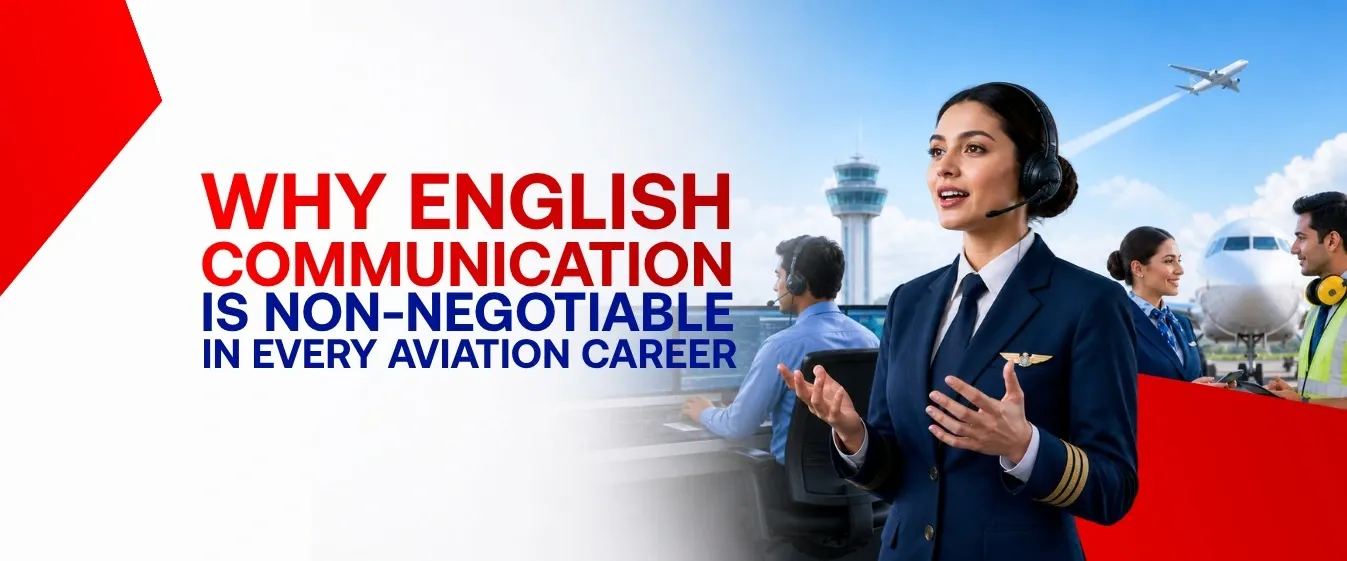
Why English Communication Is Non-Negotiable in Every Aviation Career
The Language That Keeps the Skies Safe
Every industry has its most essential skill. In finance, it is numbers. In medicine, it is precision. In aviation — whether you are standing at a check-in counter, coordinating a flight departure, managing an airport lounge, or processing cargo documentation — that skill is English communication.
This is not about being fluent like a novelist. It is about being clear, confident, and accurate in a high-pressure environment where a misunderstood word can delay a flight, create a safety hazard, or cost a passenger their connection.
Aviation is the only industry in the world where a single language — English — has been adopted globally as the official language of communication. No amount of technical knowledge can compensate for a gap in this skill.
It Applies to Every Aviation Role — Not Just Pilots
One of the biggest misconceptions among aviation students in India is that English communication is mainly a concern for pilots and air traffic controllers. That is completely wrong.
Ground staff and airport operations interact with international passengers from the moment they arrive at the counter. Standard operating procedures, gate announcements, and team coordination all happen in English. A ground staff member who cannot communicate clearly will struggle from day one.
Air ticketing and reservation officers work with GDS systems — Amadeus, Sabre, Galileo — all of which operate in English. Fare rules, booking procedures, and correspondence with airline back offices are conducted in English. This role demands both spoken and written proficiency.
Airport lounge and hospitality staff serve international premium passengers daily. A hesitant or unclear response in a premium hospitality environment reflects directly on the brand and the employer.
Air cargo and logistics professionals handle airway bills, customs declarations, dangerous goods manifests, and freight documentation — all in English. A documentation error due to a language misunderstanding can result in cargo being held at customs or financial penalties for the airline.
Aviation security officers follow BCAS regulations and international security protocols, interact with international passengers, and file incident reports — all in English. In a security context, unclear communication is not just a professional problem. It is a safety risk.
The Real Consequences of Poor English in Aviation
Poor English communication creates real, measurable problems in aviation every single day.
When a ground staff member cannot clearly explain rebooking options to an international passenger, what should be a three-minute conversation becomes a twenty-minute ordeal — and queues build behind it. When a cargo officer misunderstands a customs instruction, shipments get rejected. When a ticketing agent misreads a fare rule, the airline absorbs the cost.
Career-wise, aviation professionals who are technically strong but weak in English consistently hit a ceiling. Promotions to supervisory and managerial roles require effective communication with international colleagues, senior management, and corporate teams — all in English. Talented people lose promotions to less experienced candidates who simply communicate better.
What Aviation Employers Actually Look For
Recruiters consistently say the same thing: English communication is the number one factor that separates selected candidates from rejected ones — even when both have the same academic background.
Technical knowledge — check-in procedures, cargo documentation, security protocols — can be trained on the job. English communication ability, especially spoken confidence and professional tone, is far harder to develop after joining. Employers therefore prioritise candidates who arrive with this skill already built.
What they specifically look for: clarity in expressing complex situations, confidence without hesitation, listening accuracy on the first attempt, professional tone in a service environment, and error-free written communication.
Five English Skills Every Aviation Student Must Master
Aviation vocabulary — every role has its own terminology. Ground staff use PAX, ETD, LDC. Ticketing officers use PNR, OAL, fare basis codes. Cargo officers use AWB, DGR, ULD. Mastering these terms in correct English sentences — not just memorising abbreviations — is the foundation.
Clear spoken pronunciation — key aviation words must be understood the first time, every time. Words like departure, documentation, verification, and destination must be pronounced correctly in professional contexts.
Professional written English — emails, incident reports, passenger correspondence, and official forms must be written without grammatical errors. This is a daily requirement across every back-office aviation role.
Handling difficult conversations — aviation professionals regularly deal with frustrated or anxious passengers. The ability to stay calm, empathetic, and clear in English during these interactions is a professional skill that must be practised before entering the industry.
Active listening — mishearing a passenger's name, missing a customs instruction, or not fully catching a special request creates real operational problems. Developing strong listening accuracy in English, including understanding different international accents, is non-negotiable.